Data security and AI
The trade-offs between cloud, local and hybrid deployment, and the principles for permissions, activity logs and sensitive data.
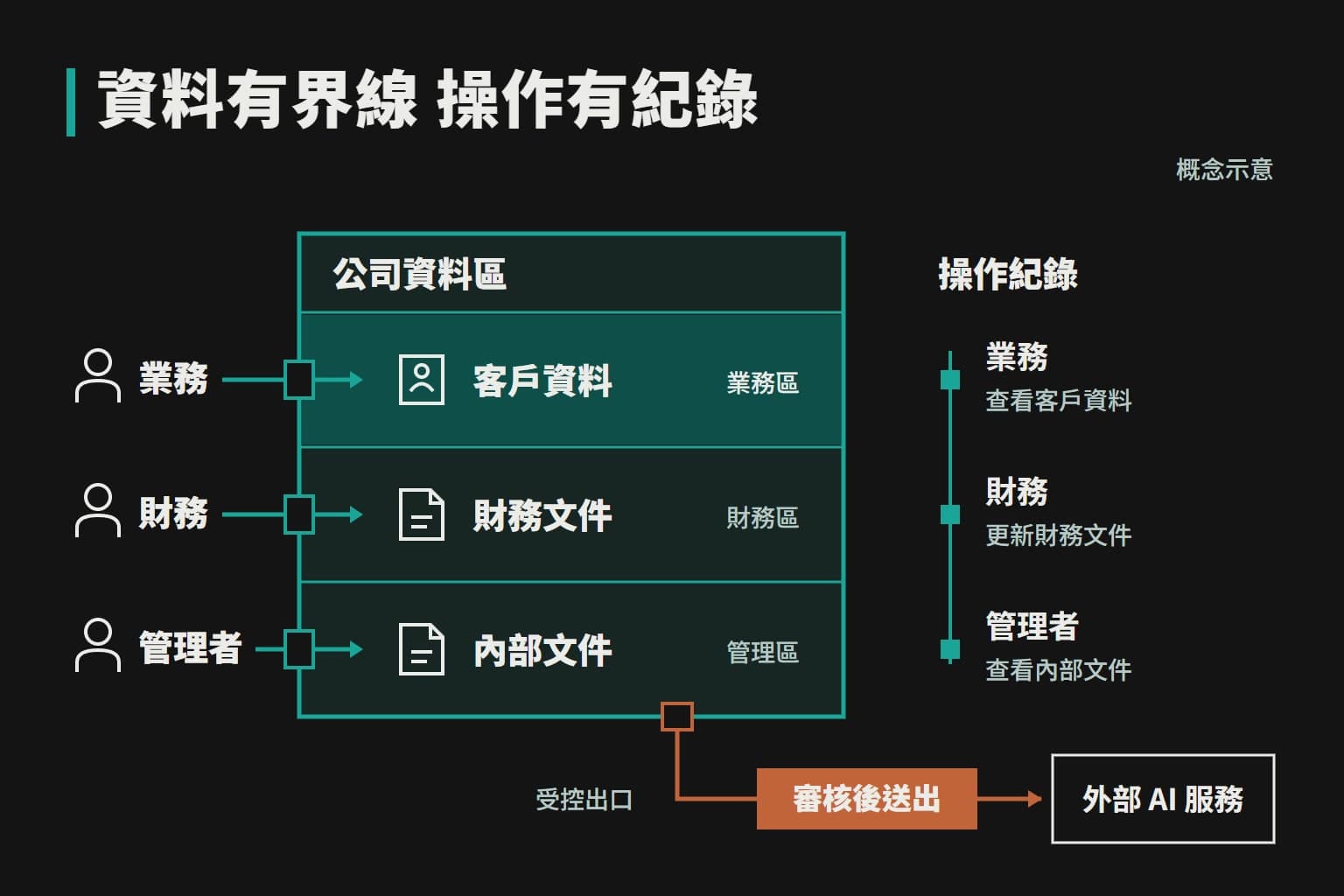
Where data goes when you use cloud AI
With cloud AI, what you send goes to the model provider’s servers for processing and the result comes back, so the data temporarily leaves your company. Enterprise APIs from large providers such as OpenAI do not train models on your data by default, which differs from the terms of typical free chat services. A provider may still retain data for a period for security monitoring, however, so confirm against each provider’s current terms.
The cloud is therefore not entirely free of risk, and how you use it should depend on how sensitive the data is. Enterprise APIs are mostly acceptable for ordinary data. For highly sensitive data, you can remove unnecessary parts first or process it locally instead.
Local AI is not always better

The advantages of local AI are that data stays inside the company, there are no usage-based model fees, and it is not affected by changes to outside service terms.
Limits to consider
- Equipment must be purchased first
- Models that can run on ordinary equipment are usually less capable than the strongest cloud models, particularly for complex judgement and long documents
- Speed drops as the number of users grows
- Someone must be responsible for equipment maintenance, model updates and data backups
- Equipment kept in your office is not automatically secure; physical access, permissions and backups must be done properly too
For ordinary data, the cloud is usually better value and quicker to start. Local or hybrid approaches are worth considering for medical records, customer confidential information, unpublished research and development data, and the like.
Hybrid deployment
Hybrid deployment keeps sensitive work inside the company and uses the cloud for everything else. For example, questions about confidential internal documents go to a local model, while external copy and the organizing of public information use a more capable cloud model.
| Cloud | Local | Hybrid | |
|---|---|---|---|
| Data | Processed on the provider’s servers, temporarily leaving your company | Stays inside the company | Sensitive work stays inside, the rest uses the cloud |
| Cost | Billed by usage | Equipment purchased first, with no usage-based model fees | Some of both |
| Model capability | The strongest models are available | Usually less capable than the strongest cloud models | Chosen by task |
| Suits | Ordinary data, and a quicker start | Medical records, customer confidential information, unpublished research data and the like | A mix of sensitive and ordinary work |
Another approach is to remove sensitive data before anything is sent. Take contractor slips in the BIKSEN back office as an example:
AI receives
- Name
- Amount
Never sent to the model
- ID number
- Bank account number
- Phone number
- Address
Before considering buying equipment, first check whether AI really needs to see this data.
Permissions and activity logs
AI permissions should match the user’s
If a salesperson has no permission to view financial data, for example, that person should not be able to obtain it through AI either. This limit has to be enforced by system permissions rather than simply by a prompt telling AI not to answer, because prompts can be bypassed by asking in various ways. Before adoption, confirm that your company’s current permissions are clear. If all data sits in folders anyone can read, organize it first.
Logs and recovery
A sound system should record what AI looked up, what it proposed and who pressed confirm.
Can usually be corrected
- Data inside a system
May not be recoverable
- Emails already sent
- Answers already given to customers
- Payments already made
The harder something is to reverse, the more firmly it should sit behind a person’s confirmation.
The risk of staff using chat tools on their own
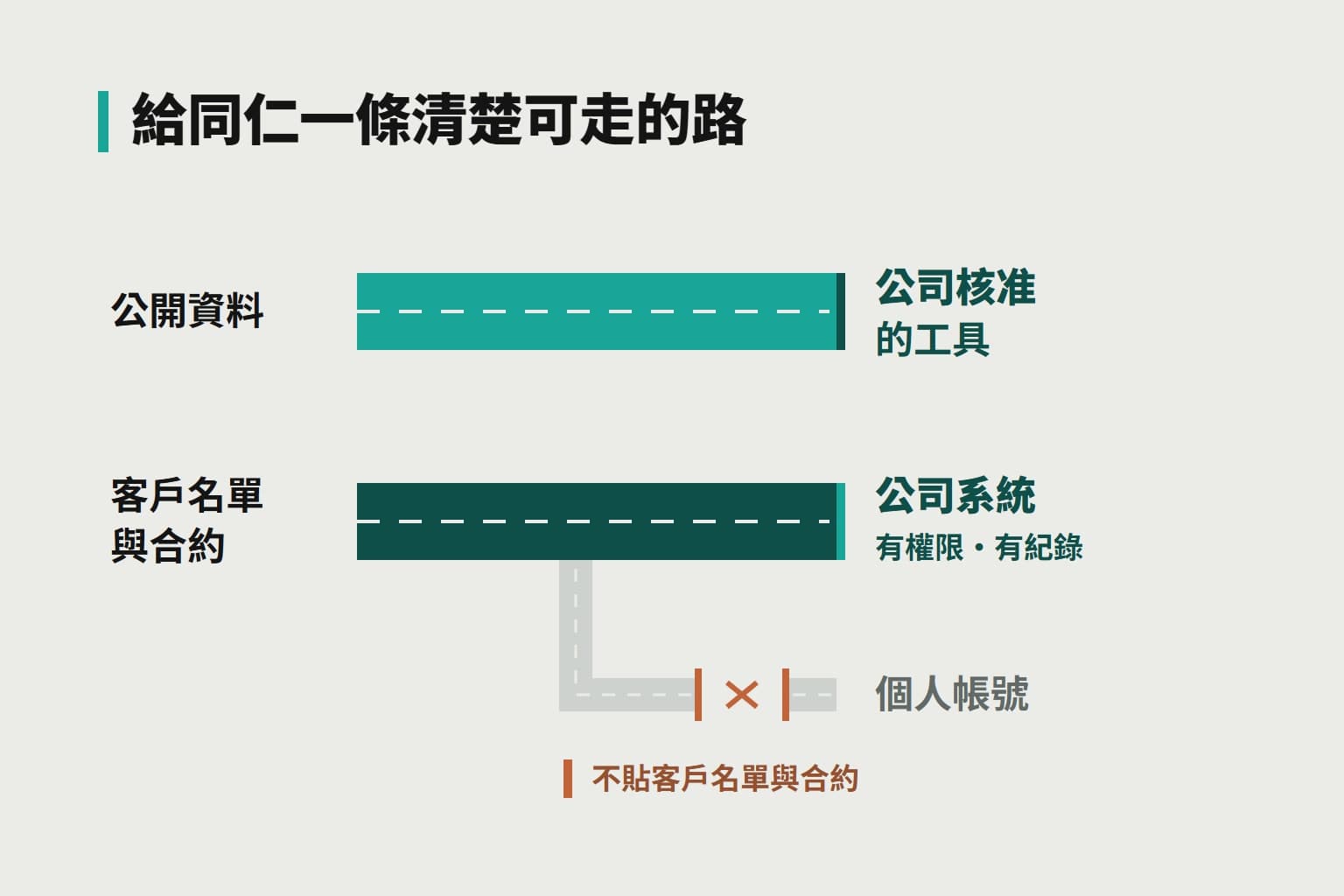
When employees use free or personal accounts, data may be used to improve models depending on the settings, and customer lists or contracts may be pasted in unintentionally. A simple ban usually has limited effect. A more practical approach is to set simple rules, explain which data must not be pasted, provide company-approved tools, and have important work go through systems with permissions and logs.
Data risks of customer-facing AI
Customer-facing AI may be led on by people asking in all sorts of ways. The most important principle is this: if you do not want customers to know something, do not put it in the AI reception knowledge base. That includes costs, gross margins, internal floor prices and other customers’ data. In addition, it should not decide discounts or commitments on its own, and conversation logs should be reviewed regularly.
Handling customer personal data
This article is not legal advice. In practice, you can start by confirming a few points: collect only what is necessary, tell customers the purpose of use, set permissions for who may process the data, delete it when it is no longer needed, and know which service providers the data goes to. Industries such as healthcare and finance may have additional rules, and we recommend consulting a legal adviser.
BIKSEN does not use client data for any other purpose. We recommend setting out the scope of confidentiality and how data is treated after the engagement ends clearly in the contract. For how this website handles data, see our privacy policy.
Further reading


This article is general information, not legal, tax or financial advice. Actual timelines, costs and results depend on each company and on written agreement.