AI reception guide
The data customer-facing AI reception needs, why answers turn out shallow, how to adjust tone, what to test before launch and how to maintain it afterward.

What data to prepare
The basics include your services and prices, business hours and location, frequently asked questions, the booking or purchase process, and your return, exchange or cancellation rules.
What your support staff reply with every day is usually the most valuable. We recommend drawing the 20 most frequently asked questions and their answers from real conversations, which is more useful than website copy. Website copy tends to be brief, and an AI given only slogans can only repeat the same content. The data does not have to be complete all at once, and can be added to gradually after launch based on real questions.
Why some AI answers are shallow
The most common reason is that the data is too thin. If there are only headings and brief descriptions, AI has nothing new to offer when a customer asks a follow-up question, so it can only rephrase what it said or turn the question back on the customer.
More data is not always better either. Duplicated content, old data that was never removed and documents that contradict each other can all lead AI to the wrong data, or even to a wrong answer.
We recommend starting from the questions customers actually ask, and writing out clearly what is actually done, who it applies to, when it does not apply, what needs to be prepared, and common situations and exceptions. Keep only one correct version of each thing, and update it as soon as anything changes.
How to adjust the tone
AI’s tone is easily influenced by what it reads. If the data reads like a specification, the answers will too, so rewriting the knowledge base in your brand’s voice is usually more effective than adding tone rules. You can look at how the employee best at serving customers speaks, and decide on forms of address and wording.
After adjusting the tone, recheck anything related to prices, times and safety, to avoid promises that go beyond what is actually offered.
When the AI cannot answer
AI should say clearly that it cannot confirm the answer and pass the matter to a person, rather than guessing. The ideal process is as follows:
- AISays it cannot confirm the answer
- AITakes down the question and contact details
- Responsible employeeIs notified and replies
- RegularlyUnanswered questions are added to the knowledge base, so answers become more complete
We recommend letting customers know from the start that they are talking to AI. Customers usually care more about whether their problem is solved. As long as the replies are correct and they can reach a person at any time, most will not object.
Where it can be placed
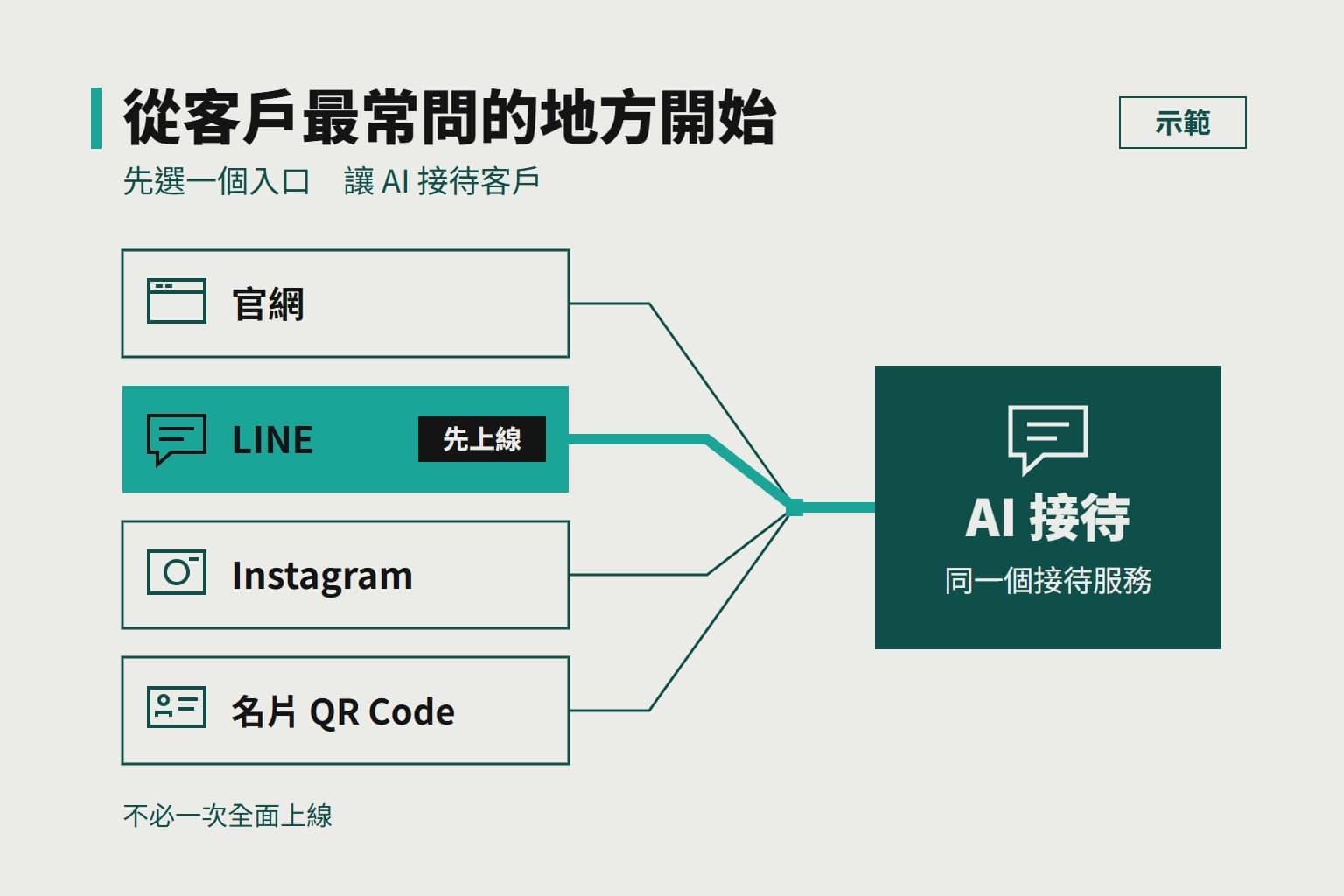
AI reception can be placed on your website, LINE, Instagram or a business card QR code. We recommend starting with the channel where customers ask the most questions, with no need to launch everywhere at once. Customer needs may also differ by channel. Website visitors, for example, are often new customers wanting to learn about your services, while those on LINE may more often be existing customers making bookings or checking orders.
Testing before launch
We recommend preparing a set of real questions that includes the following types:
- The most frequently asked questions
- Different ways of asking the same question
- Questions the knowledge base does not cover, to confirm whether it guesses
- Questions about prices, discounts and commitments
- Unrelated questions, or requests for internal data
- Three to four follow-up questions in a row, to confirm whether it repeats the same content
- The complete process from question to booking
We also recommend having people unfamiliar with the project try it, which usually reveals more problems.
Maintenance after launch
- ReviewConversation logs
- AddAnswers to questions that went unanswered or were answered poorly
- UpdateThe data when prices, policies or services change
You can review more often at first, then check periodically once things are stable. An AI with nobody maintaining it may keep giving old information, which damages trust, so we recommend assigning someone to be responsible.
Working with customer support staff
In most cases support staff are still needed, but they no longer have to answer the same questions repeatedly.
AI handles
- Repeated questions
- Out-of-hours enquiries
- Organizing what customers need
People handle
- Complex situations
- Complaints
- Important sales conversations
A starting point for AI adoption
AI reception involves internal systems less, so it is relatively quick to build and its effect is easy to see. The enquiry records it builds up help you understand customer needs and judge which workflow is worth working on next.
Further reading

This article is general information, not legal, tax or financial advice. Actual timelines, costs and results depend on each company and on written agreement.